


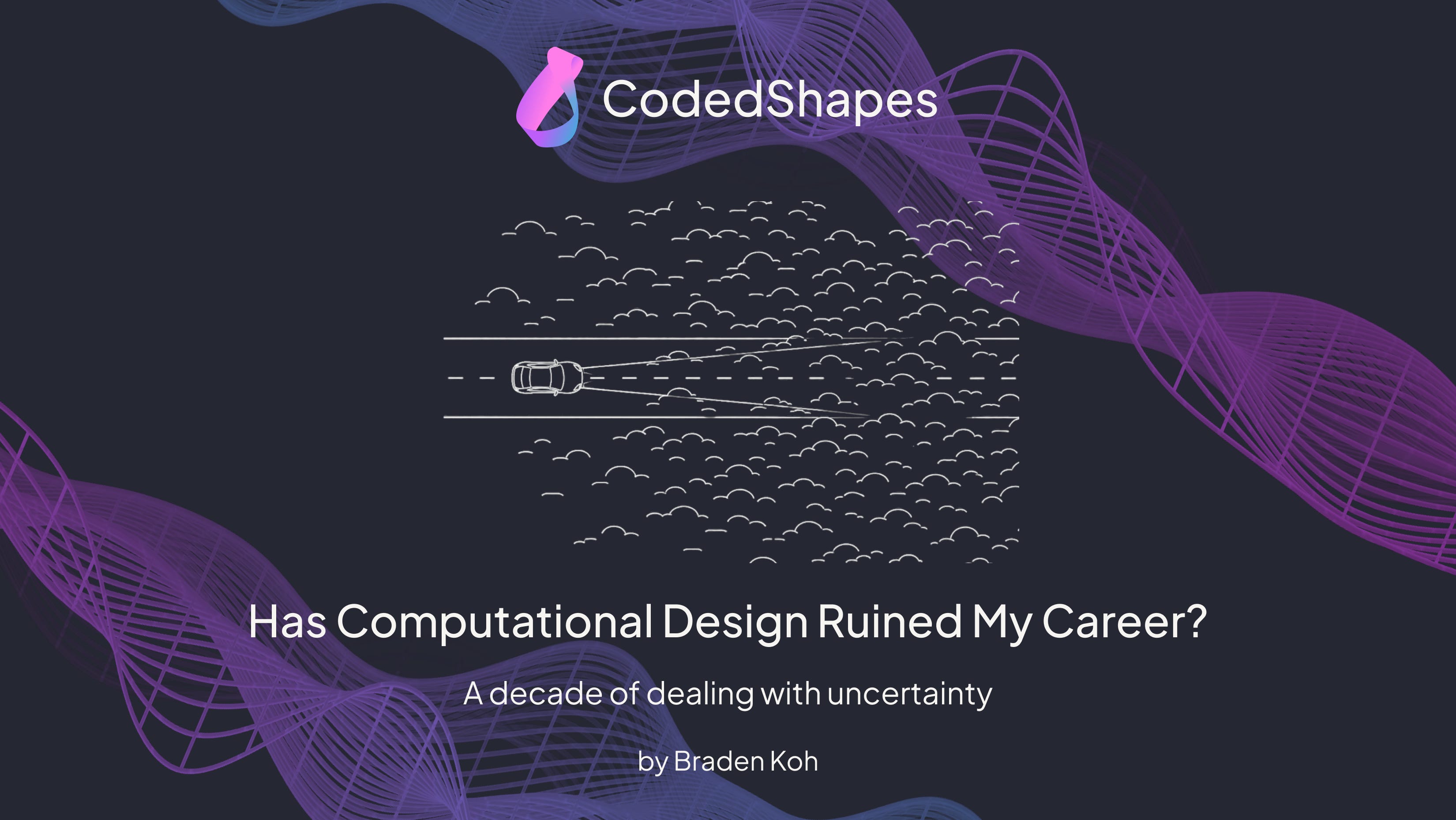
For the first few years after graduating, this single question kept me up at night the most.
I was lucky (and maybe not so lucky) because early in my career, I got a job at a structural engineering company that just started a digital team, and I was their first computational design graduate.
The concept was a team that knew engineering and code, helping create tools and workflows that made everyone else in the company more efficient. Grasshopper was all the rage back then and this company wanted to use that as an advantage. Well, and normal programming to build proprietary tools.
But really, no one knew what that actually meant. Like what progressing in the role looked like. What the team structure was going to be. How to discuss salary. Or even how to budget the team. It was all so new to everyone.
And as a graduate, I couldn’t help but worry about my future.
Especially when the rest of my cohort from university were discussing their careers. They talked about getting to senior level. About being fast-tracked to manager. Or even negotiation tactics on how to get the salary they thought they should be getting.
They looked to the future with certainty while I didn’t even know what my next year would look like. Does “senior” even mean anything in a field of less than a 100 people?
So, again, the question kept haunting me.
Am I wasting my time by doing computational design?
I wanted someone to tell me what the next step was. To show me what it meant to “climb the ranks.” To give me a promotion checklist to work on. Most importantly, I wanted someone to tell me that I was learning useful stuff for the future.
But as uncertain as things were, the work was too interesting to give up. I was coding, I was scripting, I was exploring digital concepts with clients and directors. It was one of the most interesting times of my career.
So, I soldiered on, hoping the company would overcome the growing pains of starting a new digital team.
Hi, I’m Braden
I help teams be more efficient in the AEC Industry, then share stories about it here. I also have courses, guides and scripts as part of CodedShapes Pro
Check it out if that sounds valuable.
If you’re new to CodedShapes, welcome! You might also enjoy these:
A few projects and tools (and years) later...
We still didn’t know a damn thing.
And like anything new, the interesting bits started to go stale. And this idea of being a digital person in this structural company started to really weigh on me.
I got promoted to senior. Cool, but again, no one knew what that meant. Every fortnight, we had meetings about budgets and R&D initiatives.. We had directors chasing us to create concepts that never saw the light of day.
On paper, cool stuff but no one knew how all of that got translated into value for the company and into our roles. Every performance review was tense as I kept pushing for a clearer direction and more pay (as does everyone).
At some point, I stopped waiting for the moment when the path would become obvious. And kept questioning whether I had made a terrible career decision.
Then AI showed up
At first, it was amazing.
I ignored everyone who said “AI would take our jobs” because I found myself performing at a higher level. I was executing at a speed that wasn’t possible before. Tools and workflows got created much quicker because of it. Maybe this was a way of proving my value and finally getting some direction. Maybe, this will bring back the glory days.
But then, engineers, drafters, …. everyone started using it.
And not just chatting with it, they started building their own automations, creating custom tools, connecting AI directly to their workflows. When the digital team couldn’t respond to them because of budgets or politics, they simply used AI.
Suddenly, the threat seemed real.
If people can build their own tools now, why would they need me?
In fact, a quick google tells you that domain experts make the best use of AI. If you’re an expert drafter or engineer, you can use AI to build something amazing because you know the field so well.
So, if my value is connecting people to digital tools, and AI can now do that, what is my value?
If I had focused on being a structural engineer from the beginning, I could be using AI right now to build tools because I would’ve have been a domain expert.
Instead, I’m in this weird middle ground, knowing a lot about software and the AEC industry, but not enough in either domain to be a true expert. If I had stuck to a typical engineering career and just learnt to code as a hobby, would I be in a better position?
Almost a decade later, I guess it’s the same question that still keeps me up at night.
But there’s no such thing as certainty
When I was a graduate, I wanted someone to show me the path to senior.
Then, I wanted to know how to climb the ranks. To know what was next apart from making tools and concepts.
Now, with AI so good at executing and people building their own tools, how do I move forward?
The good news is, as humans, we’re good at recognizing patterns. And the pattern here is that my career has always been uncertain. AI is just the latest version of the same feeling… I think.
And as intoxicating as it is to daydream about “if I just stuck to engineering, my life would be better”, the truth is, I wouldn’t be here if it wasn’t for this weird intersection.
I wouldn’t have started this newsletter or delivered all the incredible projects and tools in the past if I had just been a regular engineer.
And you might be feeling this too
Maybe not about computational design. But about something.
Maybe it’s the job market or the economy. Maybe, like me, it’s the thought that AI is coming for our jobs.
But as the saying goes, “the only constant is change”.
Which means, I’ll never get the certainty I crave.
Which as uncomfortable as it feels (all the damn time), it’s a good thing. It’s what I’ve had to remind myself while writing this. Certainty was never the thing that moved me forward anyway. It was following what was valuable and interesting at the time.
Whenever I waited for the path to become clear, nothing happened. But every time I just did the work because it was interesting, it opened up new pathways for me.
If you’re thinking about bringing technology into a project, I’m happy to talk through how you’re framing the problem and if it’s the right way forward
The conversation is always free
P.S. If you can’t tell, this article is more for me than it is for you. I’m dealing with a lot of uncertainty right now and writing this has reminded me how much I’ve had to navigate to get here.
P.P.S. I’ve got an announcement next week. Let’s just say I’m done waiting for the path to become clear.