


Lately, I’ve been reaching out to companies about automation. And a common response I get now is that they’d rather use AI than hire someone like me. To them, it’s $20–$150 per month plus what they already pay their engineer to build new tools. Someone I’ve worked with before even told me, “Yeah, we’ve been using AI a lot which must be a hard blow for your business.”
That is a pretty good way to trigger a small midlife crisis. Especially since, I’ve spent almost a decade solving engineering problems with programming and visual scripting, and I’ve just left my full-time job to build a consultancy around automation for firms.
When I first started using AI, I was excited by how much more I could do. It doubled or even tripled my productivity and made me so good at my job, that I hadn’t even considered what that would mean when everyone else could build things too.
And as sucky as it is, it’s just the way of the world. From their side, describing what they want in a chat looks cheaper and easier than hiring someone to build it.
Okay, that is on the tool and programming side, what about visual scripting?
A large part of my work is using tools like Grasshopper and Dynamo to build scripts and tools for projects. A lot of those projects would not have gone smoothly if it weren’t for visual scripting.
But was that just because it was easier than programming? Does the use of AI now mean that it’s actually easier to generate code than to use visual scripts ?
Hi, I’m Braden
I help teams be more efficient in the AEC Industry, then share stories about it here. I also have courses, guides and scripts as part of CodedShapes Pro
Check it out if that sounds like you.
If you’re new to CodedShapes, welcome! You might enjoy these:
Got a workflow in mind ? Let’s build it together.
The era of generic yet bespoke tools
The biggest advantage I see with AI-generated tools is being able to describe the exact workflow you want in a chat. You can give it as little or as much detail as you like, and it will move heaven and earth (on your computer) to make that happen. Even if it has to make stuff up.
It can be a small app or even a complex platform, but you get to control how it works and, to some extent, how it looks. Even if it looks similar to other AI-generated stuff out there, it’s tailored to the way you want it to work. Through a conversation and you are part of the creation process of your very own bespoke tool. It’s the IKEA effect, but for automation instead of furniture.
Compare that to giving someone a Grasshopper script. They need to get Rhino, the right plugins, then learn how to navigate the script. Even for someone experienced like me, someone else’s giant script can take a while to figure out. Not to mention, one small data format change and the script may break. You can fix it, but you have to understand enough of the components, data flow and the script itself to know where to even begin. AI-generated tools may need fixing too. But with AI, you just describe what went wrong and it’ll fix itself.
The role of visual scripting in an AI era
So, with all the downsides of visual scripting, why use it? Why not just get AI to keep whipping you up plugins for all your automation needs?
Well recently, I needed to create a parametric model of a facade baffle. In Grasshopper, that just meant connecting a bunch of geometrical and data components I already knew how to use. It took me about 2 hours to get the script up and running with the right inputs and no errors. Here’s what it looks like.
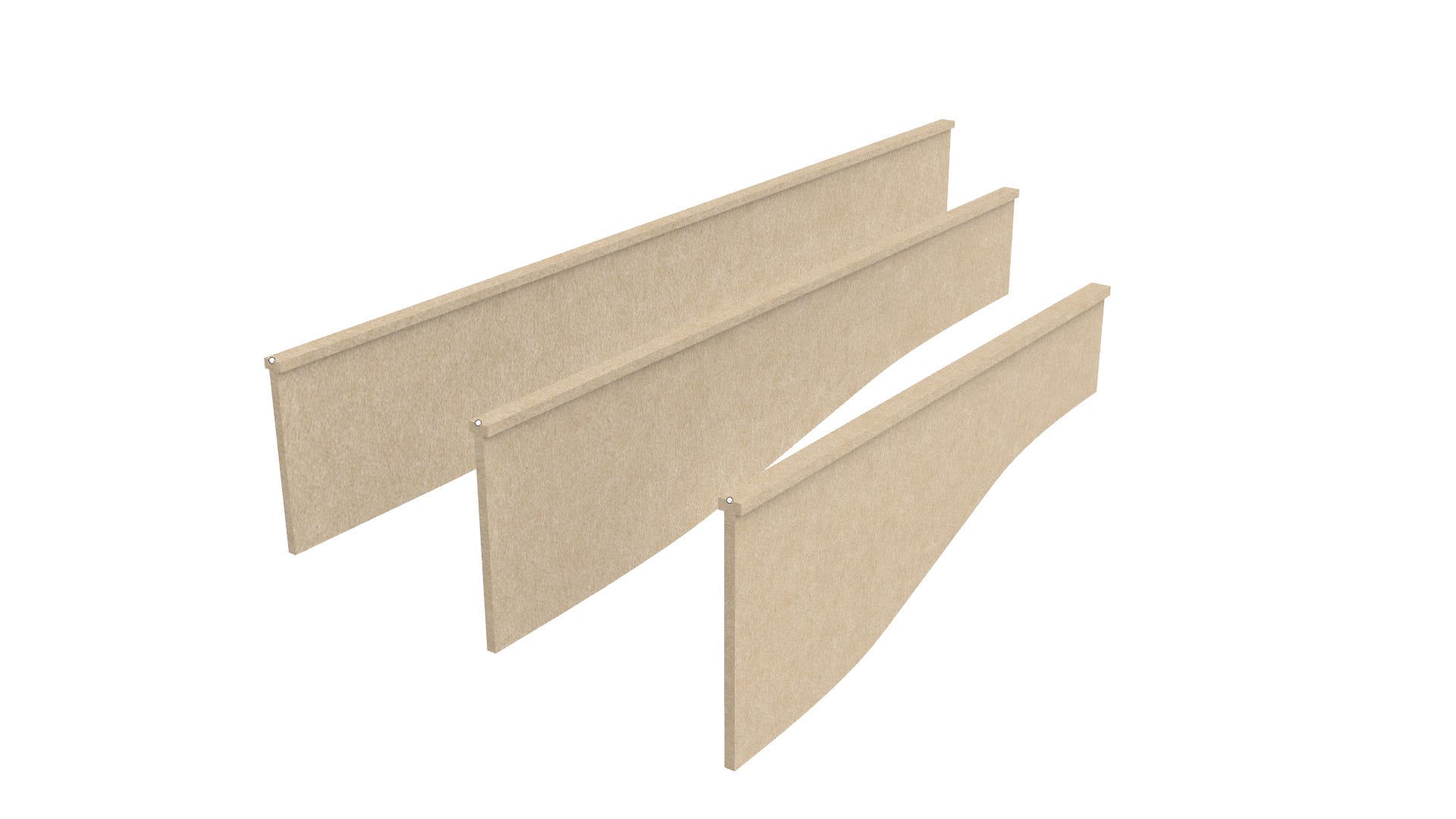
Now, imagine trying to explain that to an AI. Imagine trying to describe that with words. I think it would have taken me just as long, if not longer, to explain what I needed properly. In fact, just try explaining that to a friend with words.
Also, if I went through the AI route, it could only create that model in Rhino through scripts. Which meant I had to run it, look at the geometry and describe the fixes I wanted. Then, I’d have to delete the old geometry, get AI to make the changes and then run the script again. In Grasshopper, all I had to do is keep tweaking the components and the geometry changes. The feedback loop is instant.
Geometry can be hard to describe in words. The same goes for anything “graphical” like UI design.
I can see what I want, but explaining it with words is hard which reminds me of the Exact Instructions Challenge from a few years ago.
For geometry work and exploration like this, visual scripting is often still the quicker and better option. The instant feedback lets me see whether I got the geometry right or wrong without having to re-describe what to change.
Where I think AI takes over visual scripting is in the “tool” space. Where people used to create “tools” with Grasshopper, AI generated plugins do a much better job. A “tool” here refers to something that can be used repeatedly and by many people.
Plugins (AI-generated or not) are just easier to deploy to other teams and people. No one needs to know how to navigate Grasshopper or Dynamo just to use the tool. And since we can control how the interface behaves, we can tailor the user experience to exactly what they need to see and use. We don’t have to force our users to browse a visual script anymore. AI makes building that kind of interface and function more accessible now.
What if we add AI to visual scripting?
But, it doesn’t have to be AI vs visual scripting. What if we add AI to visual scripting? Can it overcome some of the short comings of pure AI or pure visual scripting ?
This year, Autodesk just added its Assistant to Dynamo Core 4.2, where it can generate and modify graphs. There are options for Grasshopper too, like Raven, which can build and edit scripts.
When you use AI to build a plugin or an application, checking its work means going through the code it generated. Which, maybe you can read but it’s going to be the best experience unless you really know how to use AI to generate code. But if it builds a visual script, following the components and connections is a lot easier. Especially if you know Grasshopper/Dynamo but not code.
So having AI assist us with visual scripts might mean that we get the benefits of AI but an easier time modifying it’s work than raw code.
I can see myself setting up a complex visual script for the geometry, then asking AI to help fix the data when an input format changes. Which is one of the most common errors and it’s usually the most time-consuming part to fix. With the components and connections already there, I wouldn’t have to describe the whole thing from scratch. I could point it to the problem, then follow the graph to check what it changed.
But it doesn’t take away the deployment problem. Sharing visual scripts (AI made or not) would still mean other have to know how to navigate Grasshopper / Dynamo. But it does mean that we have way more options now. Instead of AI vs visual scripts, we can opted for both now too.
So, what does this all mean?
There’s still a place for visual scripting, AI doesn’t entirely replace it.
The fact that Autodesk is adding an assistant to Dynamo means they think so too.
When I’m exploring geometry, being able to see the result and tweak it straight away is a key part of the development process. And being able to configure different ways of creating that geometry is still a very important part of the process.
Replacing that with an AI generated plugin just doesn’t make sense. The development cycle is more cumbersome and it’s hard to explain geometry to the AI in words. But adding AI to visual scripting might just give us the best of both worlds.
So, with those client conversations. AI lets their engineers build more themselves, and it makes me more efficient too. But an engineer with AI isn’t always the right setup for any problem. We’ve seen that if you don’t have the digital experience or the skillset, AI tends to suffer with geometry work and creating tools that need to scale.
As cliche as it sounds, the right solution depends on what needs building, the skills involved and how much time (money) you are willing to put into development.
Thanks for reading
Subscribe to CodedShapes to get more articles like this delivered to your inbox
Work with me: https://codedconstructs.com/contact/
Resources on Computational Design: https://www.codedshapes.com/p/scripository
Maybe it will depend if visual scripting is fast enough or if it is much slower than just a traditional coding workflow. AI agents are changing how we use IDEs. AI agents can write code much faster than humans. The way we use these tools to review code will evolve.
I think the same may apply to visual scripting tools.