



Okay, so what’s the first thing someone does when they start a new company?
You know, the one thing that’s easy to do and makes you feel productive and in control.
.
.
.
Did you guess it?
.
.
.
They build a website.
And that’s exactly what I did, a few weeks after going solo.
But I have an advantage here. I’ve built plenty of websites before, so my problem now is not the design or the tech stack. It’s the messaging. Basically, I’m trying to answer:
How do I communicate what I do to others?
Which is a problem I’ve been circling for years. I’ve written before about what happens when no one understands what you do, except back then it was a problem inside a company. Now there’s no company to hide behind.
At first, I thought the job was to prove myself
I’d just left a big-ish structural firm with a pile of projects and tools under my belt. I wanted to show every complex thing I’d built. Surely, that’s my value, right? I’d even done something like it before, so I had a template to copy.
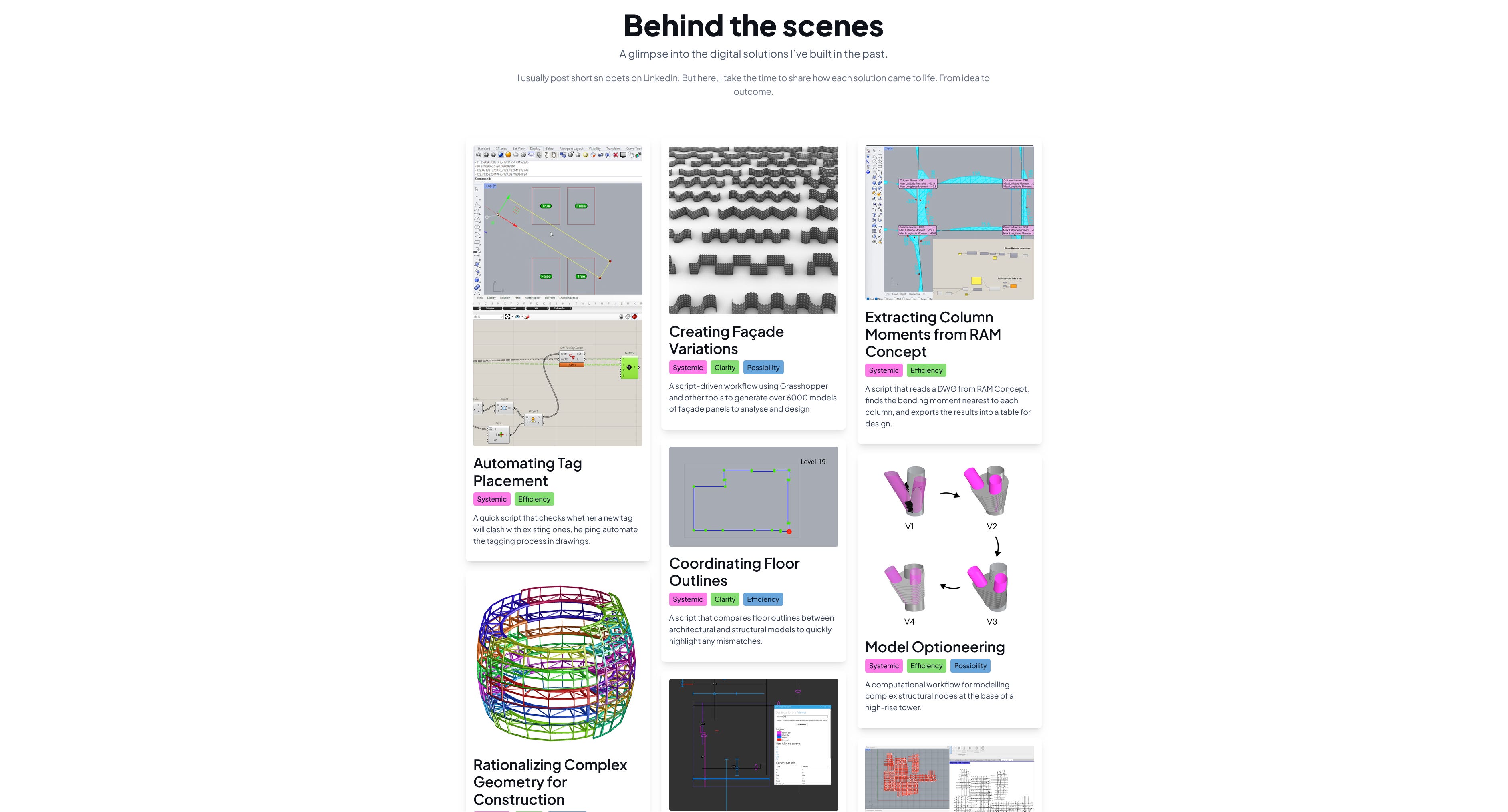
So I spent two days doing exactly that for CodedConstructs. But the more I worked on it, the more I hated it. It got to the point where I just gutted the whole thing and started again.
I just wasn’t sure what I was saying anymore.
Hi, I’m Braden
I write about the craft of computational design, from working with geometry and data to the experience of building tools for other people.
If you’re new to CodedShapes, welcome! You might enjoy these:
If you’d like help with a workflow of your own, let’s work on it together.
Round 2, cutting the flash
I didn’t hate the portfolio because I wasn’t proud of those projects. I hated it because I didn’t want to be that person. You know the type. The super-techy, know-it-all who’s always screaming “look how much value I’d bring if you’d just pay me.”
That’s the opposite of what I want CodedConstructs to feel like. I want to be your partner in solving problems. I want to show that I understand the problem and can build something that fixes it. I want the site to do what I’d do in-person, ask questions, dig into the problem, before offering anything.
A flashy portfolio is the opposite of that. All it does is alienate people. What’s worse, it says nothing about whether I can build you a tool that saves your team time and effort. It’s the same mistake as building for the demo instead of the job, just in a different medium.
In a field this abstract and confusing, I’m aiming for clarity. Not flash.
After some thinking, the way I got there was to lead with the problem, then show what it’s like to work on it.
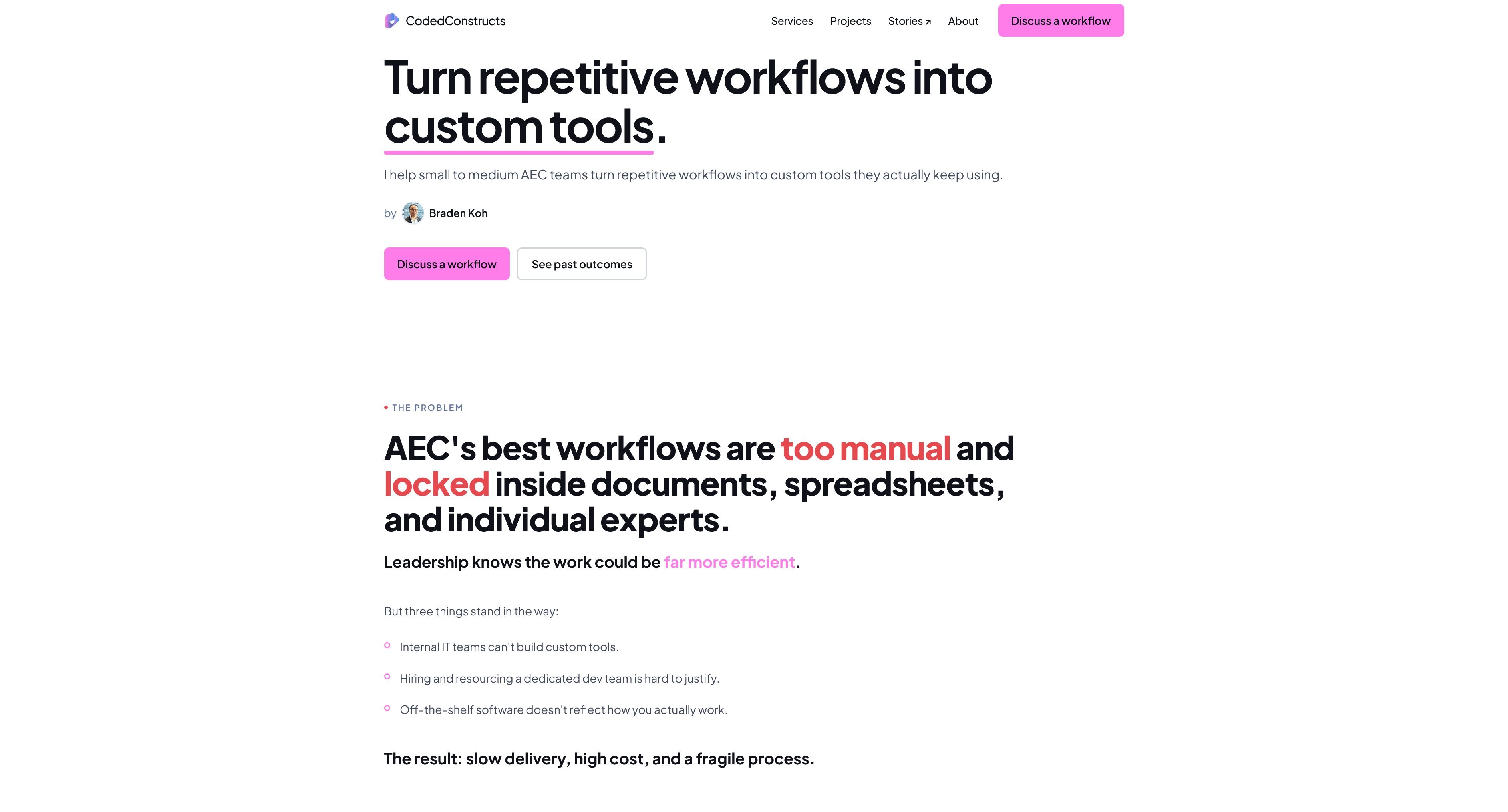
Of course, since the problem can be broad, I show the three ways I can help.
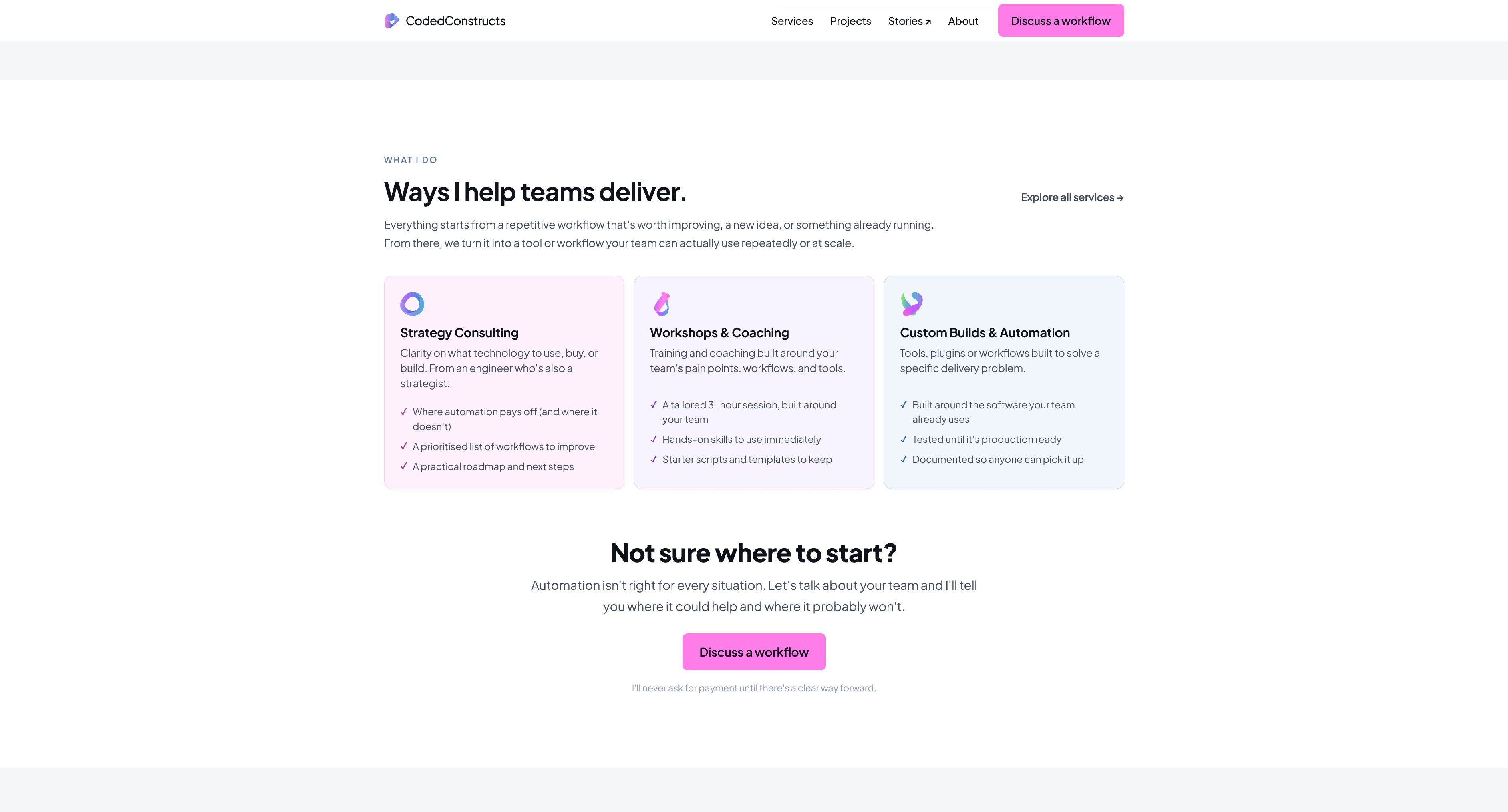
This is actually more reflective of me in real life too. I always start by trying to understand the problem first.
Showing the process
As part bringing more clarity, I wanted to show people what it’s like to work with me.
There aren’t many examples of digital work in the AEC industry, so I laid out what has worked for me in the past. Again, the goal is to take some of the blurriness out of all this digital stuff and replace it with a clearer picture of what building an effective tool actually involves. None of it is magic, it just looks that way from the outside.
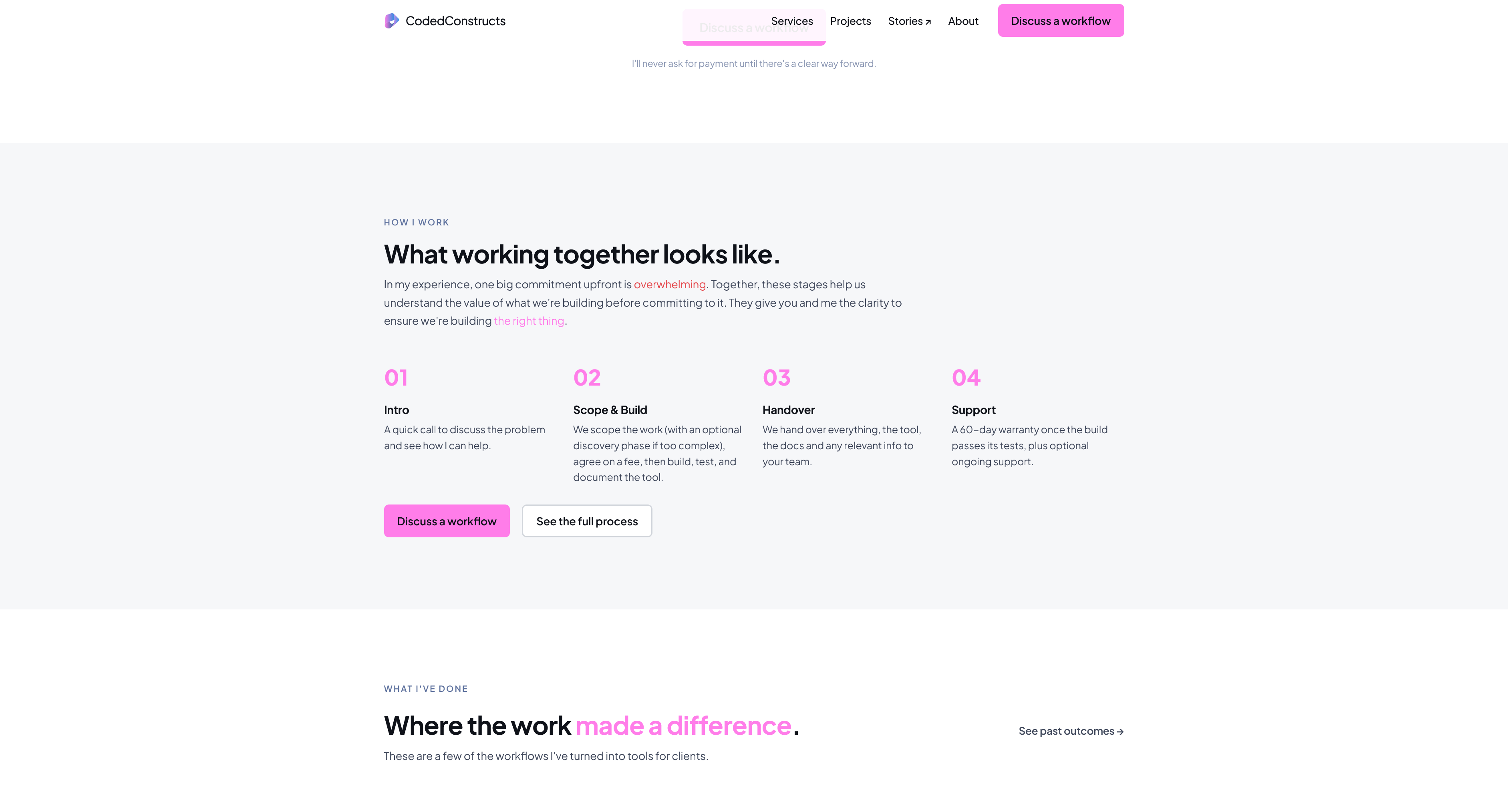
As simple as it looks on the website, most of that work was me iterating on how to articulate my own process.
Examples, not a portfolio
Cutting the traditional “portfolio” meant cutting my examples too. Which was a real loss, because examples are proof of work and they sometimes spark ideas people hadn’t considered.
What I didn’t want was the show-ey part. The big beautiful images that almost never represented the value of a digital tool.
So, I’ve gone against the grain and kept the examples light and text only. Along with a way to filter them by pattern and discipline.
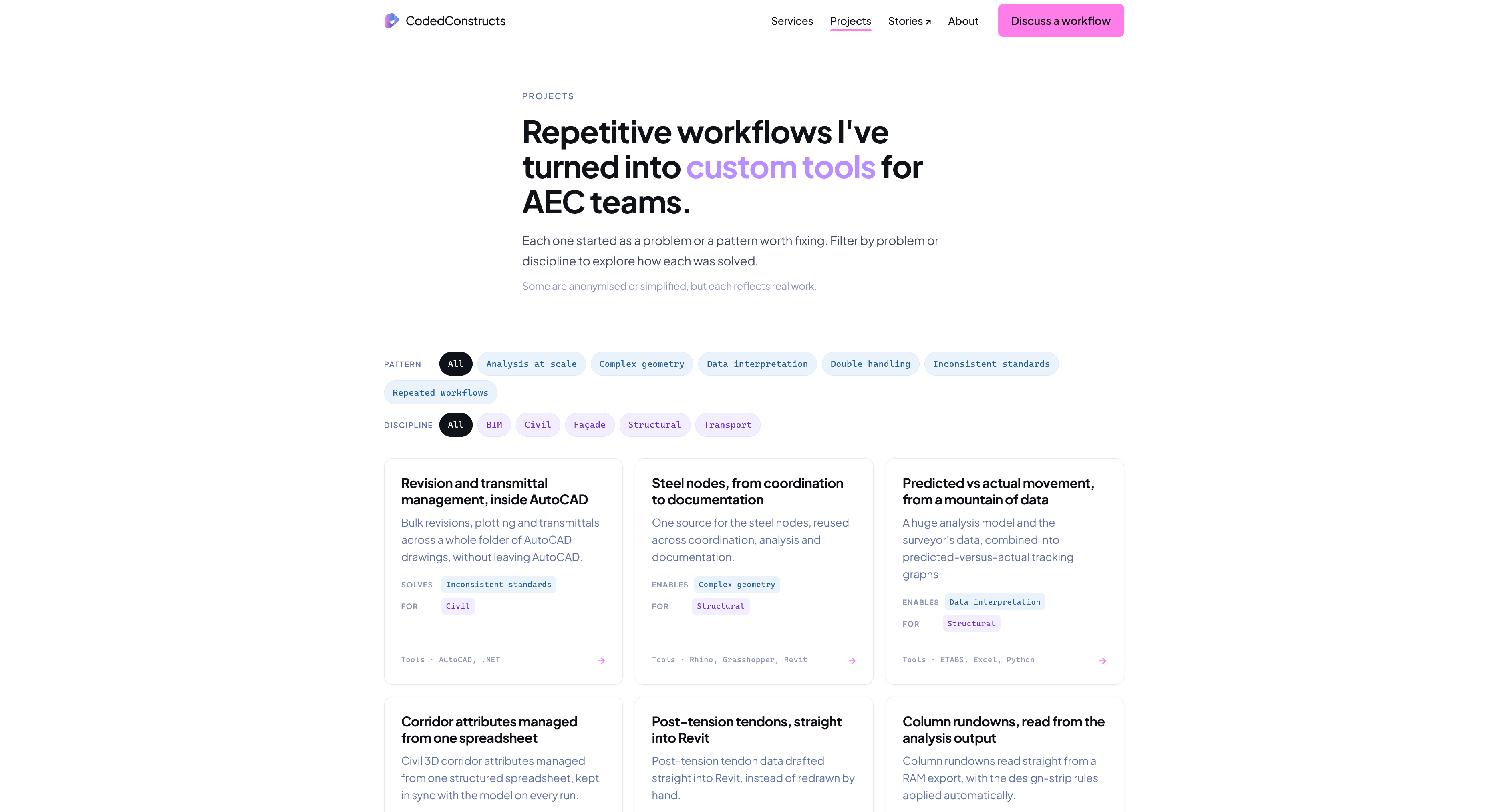
But even with text only, I kept falling back into deep technical dives about the solution. Flashy is a hard habit to break.
So, each example followed a strict format that should be skimmable by anyone.
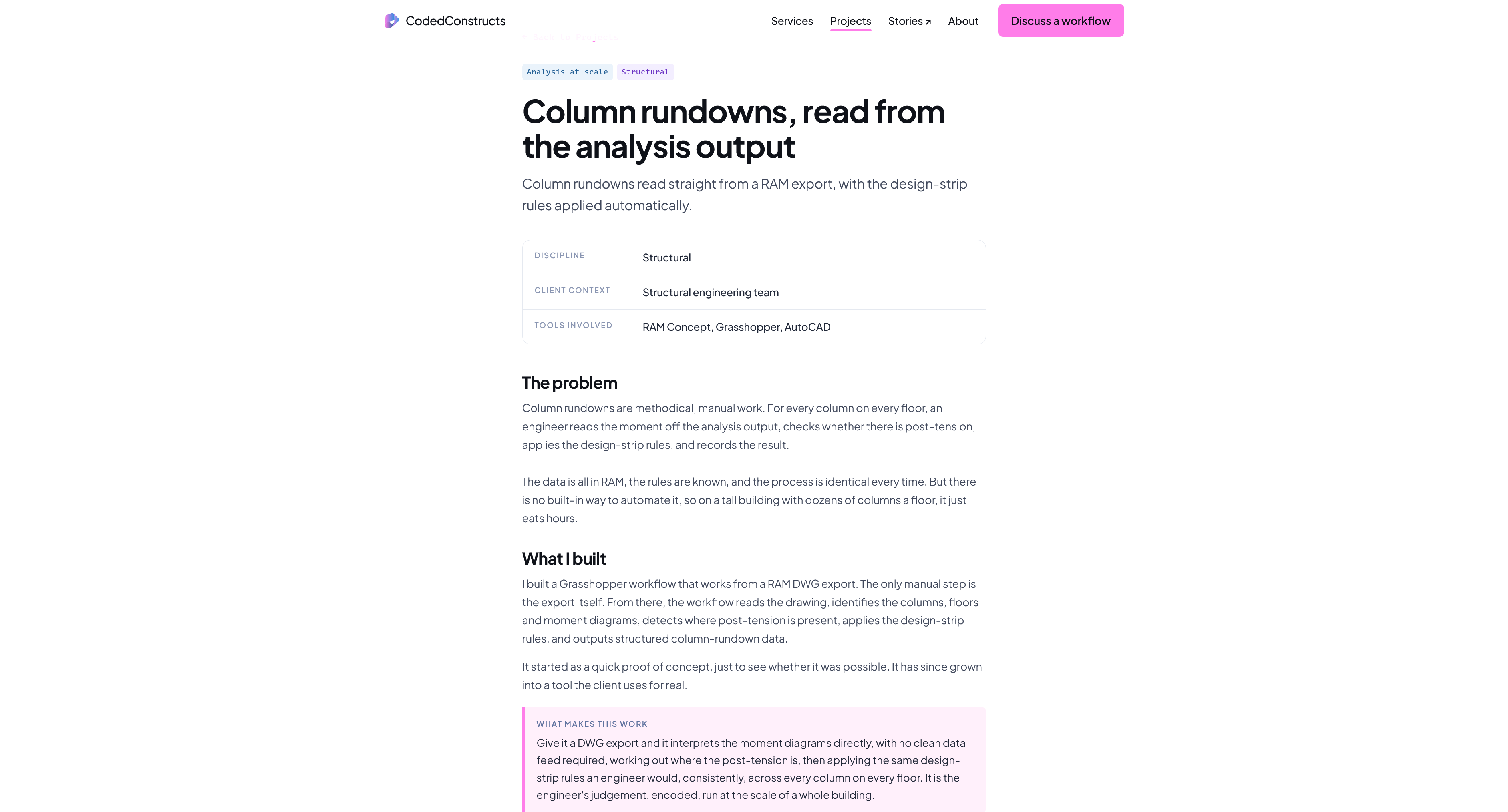
The idea here is for anyone to read and hopefully identify with an example. Then, be motivated to reach out.
I want my examples to show the value and type of work I do not to overwhelm people with “awe”.
I had to choose who not to help
This was the hardest part of the site.
Deciding who I can’t help means focusing on areas I bring the most value to. This was particularly challenging because I love solving all types of problems.
But specificity opens more doors than being broad. Saying “I build custom tools” is vague and not helpful at all, which is roughly the reason I got fussy about what I actually deliver in the first place. So, I got more specific about the firms I can best help.
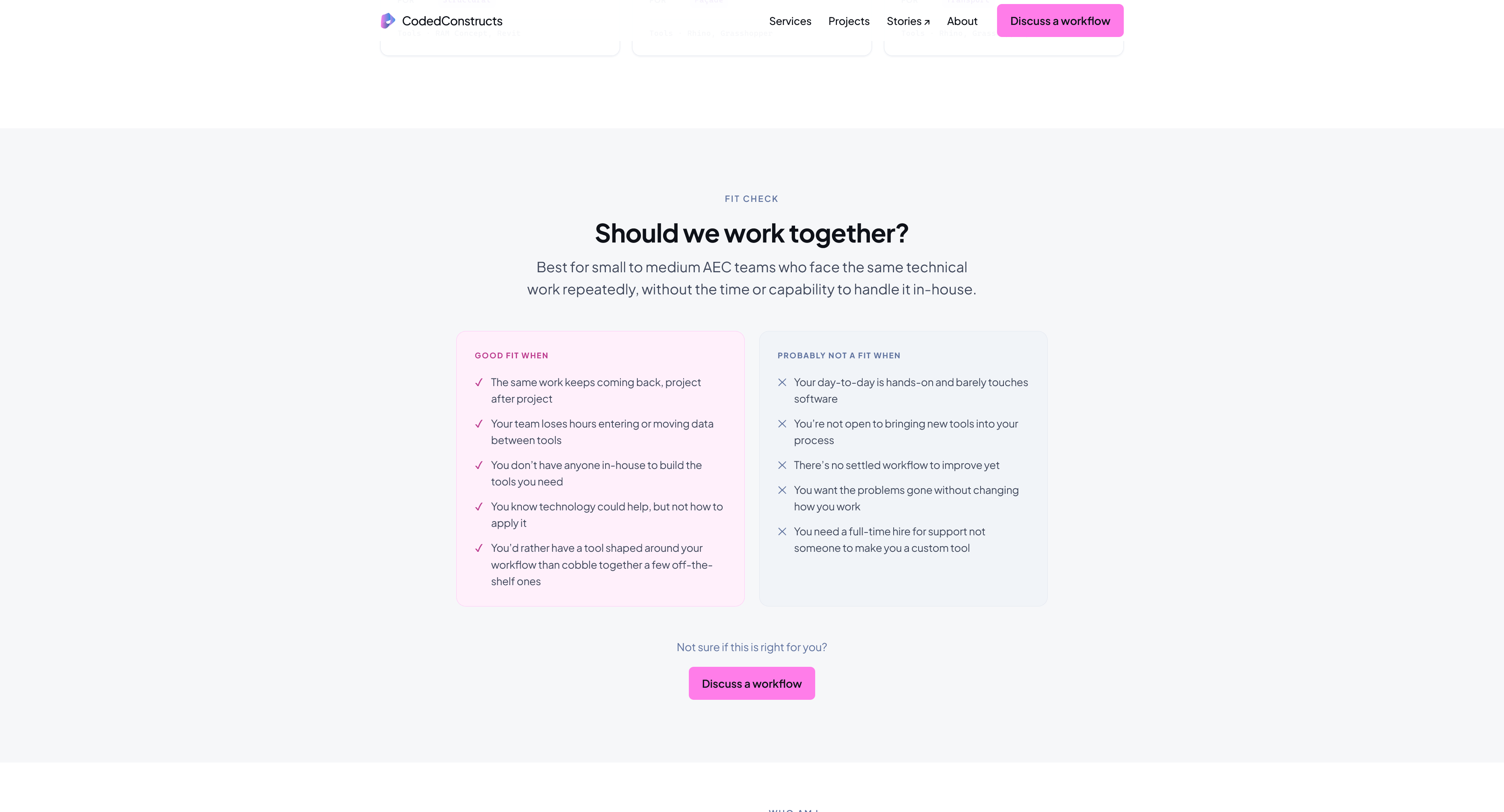
To me, it’s the small-to-medium, busy firms without the in-house capability to build tools for themselves. Big firms can afford a digital person. It’s the small-but-slammed shops that need the automation most and are least able to make it. That’s where I’ve delivered the most value.
The uncomfortable bit is that I could say yes to more. I’ve spent most of my career inside structural firms. I could offer structural advice, or drafting help. But that’s not the value I want to bring. The whole point is helping teams get more out of their computers, and I can’t do that while trying to be everything to everyone.
This is all a working theory
As certain as I sound about all this, it’s still a bet.
I’ve just started my own firm, so how I position CodedConstructs is bound to change, and hopefully the site changes with it. I’m writing all of it down as I go, messaging included.
I know a website won’t be some overnight client magnet, and most people won’t even know it exists. But it’s the one place I fully control the narrative. It’s where I get to define what CodedConstructs stands for and how I want to talk about digital work in AEC. And knowing me, I’ll keep tinkering with it forever.
Whether leading with the problem actually pulls the right people in, I honestly don’t know yet. But it’s the stance I’m taking.
Hopefully this gave you a glimpse of what CodedConstructs is about. And maybe a nudge to ask yourself the same question. How would you explain your work if you had to?
The site is live, come have a look: www.codedconstructs.com.
Thanks for reading. If you’d like more articles like this, subscribe to CodedShapes to get them delivered to your inbox
Work with me: https://codedconstructs.com/contact/
Computational Design Courses: https://learn.codedshapes.com/
Scripository (A library of computational scripts): https://scripository.com/