



For two years, I told people I couldn’t help them even though the tools they relied on for their projects kept breaking. Tools that I help make.
On paper, I had a great reason. I was working on one of the biggest projects the Melbourne office ever had. It was high-profile, massively urgent and needed all hands on deck. There were even people that couldn’t even go home during the holidays because of it.
Still, I had other drafters and engineers come to me with something broken or an improvement they needed on the tools that I helped built. But, I didn’t have the time to help because this project was the priority.
And from the company’s perspective, it’s the “right” move. The project brought in revenue and the company’s reputation was at stake. It’s even the "right” move personally because excelling on this project was the golden ticket for my manager and my manager’s boss.
But letting everyone else down because of it felt wrong. It’s shortsighted to go all in on the project and leave the internal tools broken. What would happen after the project ended? Would the glory of this project make up for letting everyone else down? Would they still trust me to build tools after this ? I am responsible for the people relying on them in the first place.
Even when I found time to help, I was always rushing. That might have made things worse, but I never knew whether I had two days or fifteen minutes before the project pulled me back in. So, I took whatever “free” time I had and went went as fast as I could. I was trying to squeeze in as much help as I could give.
If you balance project work with tool work, this is a struggle you probably know too well. It’s also a common theme I’ve touched on several times but I thought running my own consultancy meant I would have the freedom to do things differently.
But a few months in, earning money immediately through projects is still too intoxicating.
Hi, I’m Braden
I help teams be more efficient in the AEC Industry, then share stories about it here. I also have courses, guides and scripts as part of CodedShapes Pro
Check it out if that sounds like you.
If you’re new to CodedShapes, welcome! You might enjoy these:
Got a workflow in mind ? Let’s build it together.
Long term vs short term
I no longer have internal tools to build and maintain but the tools I’m building now are products I hope to sell. So, I still have to choose between paid work in front of me and building something that might become valuable later.
With project work, there’s urgency, pressure and accountability to other people. With tools, there’s still pressure but it’s less urgent. In fact, the pressure is subtler because at least for me, it comes in the form of guilt.
Guilt that I let a product idea or development sit there for weeks because I am too busy delivering on projects. I know that a well-made tool can be more valuable in the long run than spending another week on a project. But I also know that only building tools is not financially sustainable. And spending all my time on projects and I might never build the tools or develop the skills that would help me in the future.
So, as cliché as it is, there’s a balance here.
We’ve established that trying to do both makes it easy for the short-term work to win. I doubt most managers would ever prioritise an internal tool over incoming revenue. Heck, even with my own consultancy, I struggle to do it.
I told myself, “After this week, I’ll take some time to work on those products.” That was two months ago, and I still haven’t started.
Protected capacity
Okay, so I needed to do something before I got swept back into working only on projects, just as I had in my previous job.
After researching how other firms operate, I decided to try protecting my own capacity for each kind of work. I would choose how much time to give projects and products, then put that time into my calendar before the week began. Reading Richard Rumelt’s Good Strategy / Bad Strategy helped me think through the choices behind that plan. A lot of it was about taking concrete steps instead of just dreaming that the right balance would come.
First, I had to answer what am I actually trying to achieve? Both in the work itself and financially? What do I actually want ?
For me, that meant creating a sustainable business where I can provide value and work on things I want to work on. Financially, that meant I wanted to make back what I used to earn, then work out what growing that income without taking more of my time would look like.
Super vague, I know. But that gave me somewhere to start. Then with that in mind, I needed to work out how to actually do that, which is the second question.
What kind of business would let me achieve those goals?
I needed to understand what a “sustainable business” meant within what I can do and what I’m willing to do. For me, that meant taking on client projects and building my own tools to sell. I will always want a mixture of the two. I enjoy projects, and they give me problems worth solving, but I also want time to develop my own products.
I’d like to see them as equal instead of “products” just filling in the downtime between projects like most firms do. So, then what are the concrete steps I can take to get there ? How much time do I want to spend on each?
A 50/50 split between projects and products seemed like a reasonable starting point for me. But I already knew that I can’t just say that, I would have to put in place something that forces me to achieve that.
Which meant getting really clear on where I am spending my time. What I now do is look ahead one or two weeks and put “work blocks” into my calendar. These are chunks of time dedicated to projects or tools, arranged around meetings and other commitments in life.
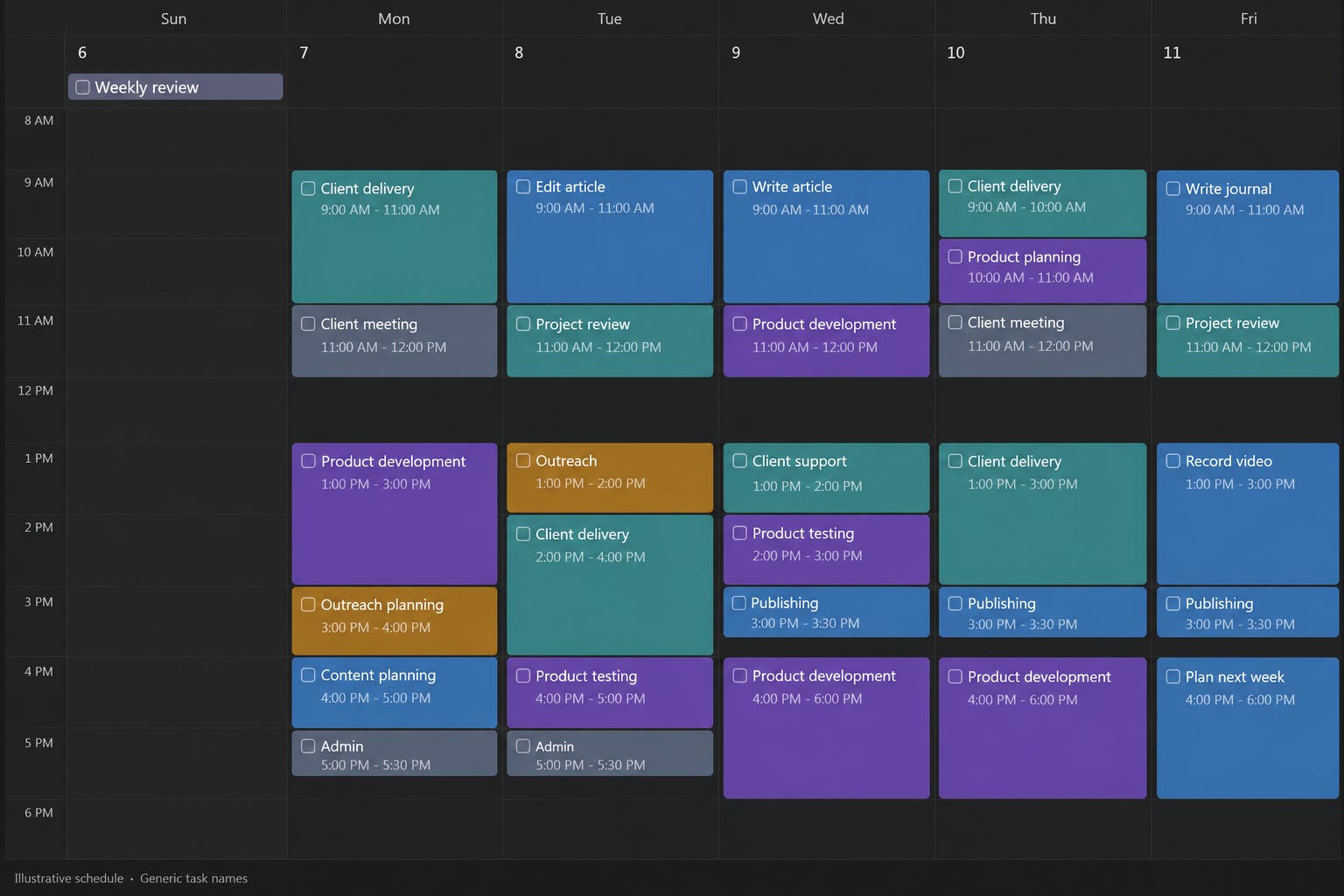
That lets me see how my time is spread out before I commit to more work. As the days progress and priorities change, I can move the blocks around and check whether I’m still making room for both.
If a project takes over a tool block, I can move that block to another day and see when I’ll return to it. That takes some of the guilt out of postponing it because I know I’ll have another session. This has been essential in stopping me from rushing product work all the time.
Making room
The blocks also give me something to review. I can look back at how I intended to spend my time and compare it with what I actually did.
Some weeks, the project is all-consuming. I can accept that. But if I still want to build products, I need to make more room for them in the weeks that follow. Otherwise, I will keep saying 50/50 while spending my time 90/10 and I am right back where I started.
I wish I’d had that clarity at my old firm. I wanted to sit down with my manager and talk about the broken tools, the people relying on them and the project commitments competing for my time. We could have weighed the consequences of delaying each kind of work and agreed on what I should do next. Instead, project work was always the number one priority, there was no conversation at all.
This whole “plan ahead with a vision” strategy works for me or even smaller teams but I can see how difficult it would be for larger firms. As simple as it is, they would still have to agree on how much time internal tools need, plan that work alongside the projects and revisit the plan when a deadline disrupts it. Combine that with office politics, role hierarchies and you’ll get a huge confusing mess.
I’m still figuring out the balance in my own business too. But I have to do something about working on all the things that matter to me instead of only on what is urgent. I want time to work through a problem properly, without wondering whether I have two days or fifteen minutes before I have to drop it again.
Thanks for reading
Subscribe to CodedShapes to get more articles like this delivered to your inbox
Work with me: https://codedconstructs.com/contact/
Resources on Computational Design: https://www.codedshapes.com/p/scripository